Terrarium Plants Guide: Safe Live Plants for Reptile Bioactive Setups
In this Article
- What is a bioactive reptile setup?
- Benefits of live plants in reptile enclosures
- Choosing plants by enclosure type and species
- Species-specific plant guidance
- The pothos and philodendron confusion: what you need to know
- Plants to avoid in reptile enclosures
- Substrate and drainage for planted enclosures
- Lighting for live plants
- Maintaining plants in an active reptile enclosure
Key takeaways
- A bioactive terrarium uses live plants, a specialized substrate, and a cleanup crew of isopods and springtails to create a self-sustaining mini-ecosystem inside the enclosure, though it reduces some maintenance rather than replacing regular cleaning, ventilation, and veterinary care
- Plant selection depends on two things: your reptile’s species (specifically what they’ll eat and how they interact with plants) and your enclosure’s humidity and temperature range
- Pothos, spider plants, bromeliads, and ferns are reliable choices for tropical and humid setups; aloe, haworthia, echeveria, and drought-tolerant herbs work well for arid enclosures
- Herbivorous and omnivorous reptiles like bearded dragons need edible plants throughout their enclosure because they will eat what they can reach. Treat only well-established species as edible and keep questionable plants out of reach
- The biggest overlooked hazards in live plant setups are pesticide and fertilizer residue from garden-center plants. Use botanically identified, pesticide-free plants, repot them in organic substrate, and rinse them thoroughly before introducing them to your pet’s enclosure.
- Pothos and some philodendrons look nearly identical and are both oral irritants, so always confirm which plant you have before adding it to an enclosure
Live plants transform a reptile enclosure from a functional habitat into something that more closely resembles the natural environment your animal friend comes from. Done well, a planted bioactive setup supports better humidity, richer enrichment, and a healthier overall ecosystem for your reptile.
This guide covers everything you need to choose plants safely and set up a planted enclosure that works for your pet, from the most popular low-maintenance options for tropical setups to what can gro in an arid desert enclosure.
What is a bioactive reptile setup?
A bioactive enclosure is a living ecosystem rather than a static display. It combines live plants with a deep, layered substrate and a “cleanup crew” (CUC) of small invertebrates, typically isopods (like dwarf white isopods or Armadillidium species) and springtails, which break down waste, shed skin, and uneaten food naturally.
The result is an enclosure that maintains itself more effectively than a traditional setup: plants help regulate humidity, the cleanup crew helps break down some organic matter (though feces, urates, and spoiled food still need prompt removal), and the substrate stays biologically active rather than just inert. This creates a more naturalistic and stimulating environment for the reptile, and many keepers find the day-to-day maintenance less intensive once the system is established.
Bioactive setups require more careful planning upfront, particularly around plant selection, but they reward that investment with a more visually engaging and functionally healthy habitat. For a foundation on reptile habitat setup generally, a set-up guide for reptile habitats covers the essentials.
Benefits of live plants in reptile enclosures
- Humidity regulation: Live plants bring moisture into the enclosure, which helps maintain the humidity gradients that tropical and semi-tropical species depend on. This is particularly valuable in captive enclosures that tend to dry out faster than natural environments, such as tanks with mesh lids.
- Enrichment and behavioral stimulation: Plants add complexity to the enclosure. They create climbing routes, hiding spots, visual barriers, and new textures to investigate, all of which support more natural behavior and reduce stress-related behaviors like repeated pacing or excessive hiding.
- Cover and security: Reptiles that feel exposed often spend more time hiding and less time active. Dense plant cover gives them the sense of security that reduces baseline stress, particularly for naturally shy species like leopard geckos, ball pythons, and many tropical lizards.
- Natural aesthetic: A planted enclosure is much more interesting than a bare-substrate setup. For species you spend time watching, this matters as much for you as it does for your reptile.
- Air quality: Plants produce oxygen and absorb carbon dioxide, but in a ventilated enclosure their effect on air quality is minor. They do not replace proper ventilation or the removal of waste.
Choosing plants by enclosure type and species
The most important variables in plant selection are humidity level, temperature range, and what species of animal you are keeping as not all plants are safe for all species. These factors determine which plants can actually survive in the environment you’re building, and which ones are safe if your reptile decides to sample them. Whatever you choose, start with pesticide-free plants. Many garden center plants are treated with systemic pesticides that cannot be rinsed off, so source carefully and quarantine new plants before use (see the FAQ below).
Tropical and humid enclosures
Species: crested geckos, chameleons, Chinese water dragons, tree frogs, anoles, and similar tropical reptiles.
These enclosures maintain higher humidity (typically 60 to 80% or above) and moderate to high temperatures. This environment supports a wider variety of readily available houseplants, many of which are ideal for bioactive setups.
- Pothos (Epipremnum aureum): The most widely used terrarium plant for a reason. It handles high humidity and lower light conditions, roots readily in organic substrate, and creates excellent coverage. Herbivorous and omnivorous reptiles may nibble the leaves, so see the species-specific notes below before offering access.
- Spider plant (Chlorophytum comosum): Non-toxic, adaptable, and produces trailing runners that add visual interest. Well-suited for enclosures with climbing species.
- Earth Star bromeliad (Cryptanthus bivittatus) or Neoregelia b romeliad s: Excellent for tropical setups. Their natural cup-shaped center holds water, which many species drink from, and they provide natural perching and cover. Multiple varieties available in a range of sizes.
- Ferns (bird’s nest fern, Asplenium nidus; Boston fern, Nephrolepis exaltata; staghorn fern, Platycerium bifurcatum): Humidity-loving and generally safe for reptiles. Bird’s nest fern is particularly robust and handles the conditions inside most tropical enclosures well.
- Creeping fig (Ficus pumila): A versatile ground cover that adheres to surfaces and creates a naturalistic backdrop. Works especially well climbing along the back wall of an enclosure.
- Radiator plant (Peperomia obtusifolia): A low-maintenance option that tolerates the relatively lower light inside an enclosure and adds upright, leafy structure to the middle levels of the enclosure.
Arid and semi-arid enclosures
Species: bearded dragons, leopard geckos, uromastyx, blue-tongued skinks, tortoises.
Desert and arid setups present a challenge for live plants: low humidity, high temperatures, and a basking spot that most plants simply can’t tolerate. Plant selection is more limited here, but there are genuinely good options that thrive in these conditions.
- Aloe (Aloe vera): Handles heat and low humidity well. A standard small aloe positioned away from the hottest part of the basking area can survive and add texture. Note: some aloe varieties have spiny leaf edges, and aloe has edibility concerns for some reptile species, so see the bearded dragon section below.
- Zebra haworthia (Haworthiopsis attenuata): A small, slow-growing succulent that’s generally considered safe and handles arid conditions with minimal water. Works well in the cooler areas of the enclosure.
- Blue rose echeveria (Echeveria imbricata): Compact rosette succulents that tolerate dry heat. Visually appealing and structurally hardy enough to withstand a curious reptile.
- Burro's tail (Sedum morganianum) (or another non-toxic sedum species): Low-growing ground cover for arid setups. Tolerates heat and drought. Avoid Sedum acre specifically, which has irritant properties.
- Rosemary (Salvia rosmarinus), thyme (Thymus vulgaris), or oregano (Origanum vulgare): These Mediterranean herbs are drought-tolerant, thrive under strong lighting, and are safe for bearded dragons and tortoises to eat. They’re an excellent choice for omnivore and herbivore enclosures where the animal will inevitably sample the plants.
- Sky plant (Tillandsia ionantha) or Xerographica air plant (Tillandsia xerographica): Require no soil, but they are not no-care plants. They need periodic hydration and good airflow, and can survive in some dry enclosures with regular misting or soaking. Attach them to decorative branches or cork bark to make their care easier.
Species-specific plant guidance
Bearded dragons
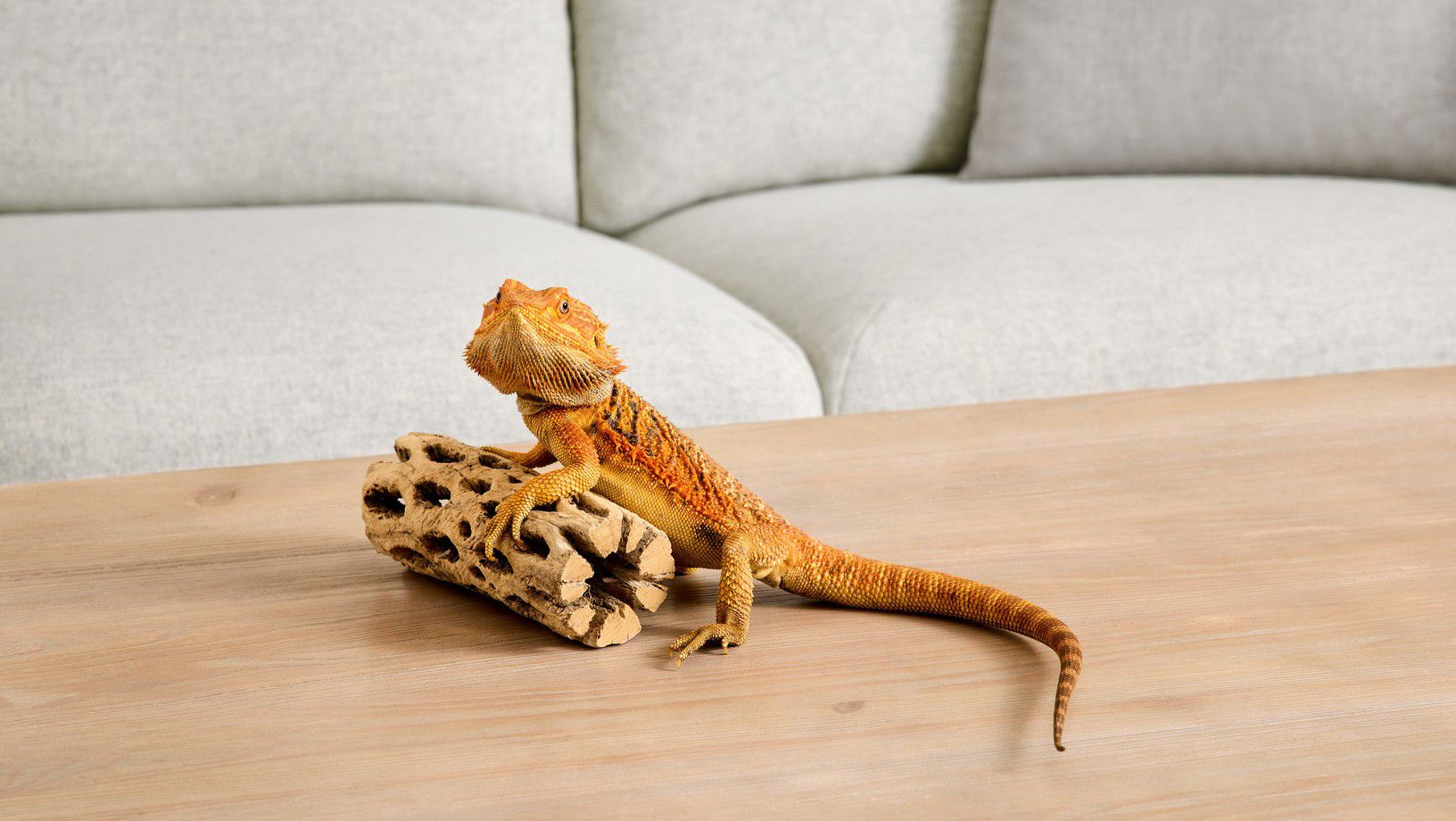
Bearded dragons are omnivores with a strong instinct to investigate and eat green vegetation. This means every plant in their enclosure needs to be both safe to ingest and capable of surviving the heat of an arid, desert set up, reminiscent of their Australian roots. Avoid any plant with known toxicity concerns, and remember that "safe" is not equally established for every species, cultivar, or quantity. Aloe can cause gastrointestinal upset and should not be treated as a routine food plant. Echeveria and sedum have limited reptile-specific safety information, and rosemary and thyme are better viewed as occasional edible herbs than staple vegetation. For regular feeding, offer well-established greens such as dandelion, clover, plantain, watercress, rocket, and chicory. Pothos and philodendron should be avoided in bearded dragon enclosures where the animal can reach them.
For a full guide to bearded dragon care and habitat requirements, what do I need for my bearded dragon tank setup? and the bearded dragon care guide cover the essentials.
Leopard geckos
Leopard geckos are insectivores and won’t seek out plants as food. This opens up slightly more flexibility in plant selection, since the primary concern shifts from edibility to environmental suitability. Pothos in a hanging or elevated position that your leopard gecko can use for cover but won’t ingest works well. Small succulents in the cooler area of the enclosure add cover and texture. Leopard geckos appreciate multiple hiding spots more than climbing cover, so dense low plants or cork bark paired with small succulents is often more useful than vertical plant arrangements.
See the full leopard gecko care guide and leopard gecko checklist for complete habitat requirements.
Crested geckos
Crested geckos are arboreal (tree-dwelling) and thrive in tall, well-planted tropical enclosures with plenty of vertical climbing coverage. Pothos is the go-to plant for crested gecko setups for good reason: it grows quickly, creates canopy cover at the upper levels where crested geckos spend most of their time, and is extremely hardy. Bromeliads, spider plants, and ferns add variety and additional cover. Because crested geckos are insectivores and frugivores, they do not typically graze on foliage. However, they can still chew plants and accidental ingestion is possible, so plant safety still matters.
The pothos and philodendron confusion: what you need to know
This is one of the most important things to understand before buying plants for a reptile enclosure: pothos and philodendron look nearly identical, are often mislabeled in garden centers and big-box stores, and carry the same calcium oxalate risk for reptiles.
Both plants contain calcium oxalate crystals, which can irritate the mouth and digestive tract when the plant is chewed or bitten, even if it is not swallowed. Pothos (Epipremnum aureum) is widely used in reptile enclosures and is considered safe for insectivorous and carnivorous reptiles that won’t eat it. However, neither plant is more toxic than the other. Both are oral irritants, and eaten in excess either can cause problems, so keep both out of reach of omnivores and herbivores that actively graze..
When buying pothos, look specifically for the label “Epipremnum aureum” or confirm with the seller. If you’re uncertain whether a plant is true pothos or a philodendron, buy from a reptile-specialized retailer rather than a general garden center to reduce the risk of mislabeling. As a quick check, pothos leaves are usually thicker and waxier, while new philodendron leaves emerge from a thin, papery sheath that later dries and falls off.
Plants to avoid in reptile enclosures
The following plants should not be included in a reptile habitat, either because they are toxic if ingested or because they pose a direct contact hazard.
- Dieffenbachia: Contains calcium oxalate crystals that cause severe oral and gastrointestinal irritation. Even contact with the sap can cause irritation. Keep this out of all reptile enclosures.
- Oleander (Nerium oleander): Highly toxic due to cardiac glycosides. All parts of the plant are dangerous if ingested and should never enter a reptile habitat. Oleander is also toxic to other pets, including dogs and cats.
- Peace lily (Spathiphyllum): Contains calcium oxalates and carries the same oral irritation risk as pothos and philodendron. Keep it out of enclosures with plant-eating reptiles.
- Euphorbia species: Produces a milky latex sap that is highly toxic and severely irritating on contact. Branches are brittle and designed to break and release sap. Absolutely avoid.
- English ivy (Hedera helix): Listed as toxic for many animals. Best avoided, particularly in enclosures with herbivorous or omnivorous reptiles.
- Philodendron (for herbivores and omnivores): As discussed above, philodendron carries the same oral irritation risk as pothos, so keep both out of any enclosure with a plant-eating reptile.
- Lily of the valley, foxglove, azalea, rhododendron: All toxic with significant health consequences for reptiles and mammals.
When in doubt about any plant, err on the side of exclusion. The range of safe, effective, and widely available plants is broad enough that there’s no need to take risks with questionable species.
Substrate and drainage for planted enclosures
A planted bioactive enclosure requires a deeper and more structured substrate than a traditional setup. Many tropical setups use two layers, but a drainage layer is optional and depends on the enclosure design. An arid enclosure is often better served by a well-draining substrate without a permanently wet lower layer.
- Drainage layer: An optional base of appropriately sized LECA (lightweight expanded clay aggregate) or lava rock, typically two to four inches deep. This layer prevents the substrate above from becoming waterlogged, which would kill plant roots and create unhealthy anaerobic conditions. A layer of synthetic mesh is used to prevent soil from falling into this layer and impeding drainage.
- Topsoil layer: An organic, additive-free substrate above the drainage layer. For tropical enclosures, a mix of topsoil with coconut coir and orchid bark provides good structure and moisture retention. For arid enclosures, a sandier, faster-draining mix is more appropriate.
The substrate depth matters: shallow substrate doesn’t allow plant roots to establish or give the cleanup crew enough depth to work effectively. For most bioactive setups, aim for at least four to six inches of combined substrate depth.
For species-specific substrate recommendations, the lighting and climate guidance in our PetSmart Care guides. Articles like what climate does my reptile need? and how much heat and light do reptiles need? Also provide useful context.
Lighting for live plants
Most reptile UVB lighting setups provide enough light to support moderate and low-light plants like pothos, ferns, and many succulents. If your enclosure uses strong basking lights, position light-loving plants near the light source and shade-tolerant plants away from the hottest zones.
For enclosures where you want more demanding or higher-light plants to thrive, adding a dedicated plant grow light alongside the reptile-specific UVB and heat setup gives plants what they need without interfering with your reptile’s requirements. Many keepers run a separate grow light on a timer that aligns with the daytime photoperiod.
Low-light plants that consistently perform well in reptile enclosures: pothos, ferns, spider plants, and radiator plant (Peperomia obtusifolia). High-light plants that need supplemental lighting: most succulents and drought-adapted herbs like rosemary and thyme perform best under strong, direct light and may become leggy or die back without it.
Maintaining plants in an active reptile enclosure
- Secure planting: Reptiles will dig, climb, and occasionally bulldoze plants. Anchor plants securely using rocks, cork bark, or planting them deep enough that roots establish before the animal disrupts them. Larger, heavier pots or planters inside the enclosure resist casual disruption from most species.
- Water by the plant, not the enclosure: Overwatering is the most common cause of plant death in enclosed setups. Water soil directly when it’s dry to the touch rather than misting the whole enclosure. Succulents and arid-setup plants especially need to dry out between waterings.
- Trim and prune regularly: Pothos and other fast-growing tropical plants can take over an enclosure if left unchecked. Regular trimming keeps growth manageable and can be used to propagate new plants for free.
- Monitor for plant damage: A reptile that’s consistently digging up or eating a specific plant is giving you useful information. Adjust placement, add more hardscape to redirect digging behavior, or swap out the plant for something hardier.
- Replace as needed: Not every plant will thrive in every setup. If a plant isn’t doing well after a reasonable establishment period, swap it for something better matched to the specific conditions in your enclosure.
In this Article
- What is a bioactive reptile setup?
- Benefits of live plants in reptile enclosures
- Choosing plants by enclosure type and species
- Species-specific plant guidance
- The pothos and philodendron confusion: what you need to know
- Plants to avoid in reptile enclosures
- Substrate and drainage for planted enclosures
- Lighting for live plants
- Maintaining plants in an active reptile enclosure