
How to Manage Dog Anxiety While Traveling
In this Article
Key takeaways
- Travel anxiety is common in dogs and can stem from unfamiliar environments, motion, sounds, confinement, or simply the disruption of routine
- Crate and carrier acclimation done well before the trip is one of the most effective anxiety reducers available, and it costs nothing but time
- Withhold food four to six hours before travel to reduce nausea, a common contributor to car anxiety
- Sedation is not recommended for air travel: it suppresses a dog’s ability to balance and breathe effectively, particularly in cargo holds
- Calming supplements, pheromone products, and anxiety wraps can help with mild to moderate travel stress; prescription options are available for significant anxiety
- Your own energy matters: dogs read their people, and a calm, matter-of-fact approach from you makes a real difference
Many dogs don’t love exploring new places right alongside their favorite person. A new car, unfamiliar smells, a busy airport, or a hotel room that’s not home, can still feel disorienting or stressful for a dog who isn’t used to it. The good news is that travel anxiety is manageable. With the right preparation, the right tools, and a realistic sense of how your dog handles new situations, you can make travel a great experience for both of you. This guide covers why dogs get anxious during travel, how to recognize the signs, what to do before you leave, and how to handle the specific challenges of road trips, air travel, and new environments.
Why dogs get anxious when traveling
Travel stacks multiple stressors together in a short period of time. Any one of them might be manageable on its own. Together, they can overwhelm a dog who doesn’t have positive associations with travel.
- Motion and physical sensation: Car rides involve movement, vibration, and sound that some dogs find genuinely nauseating. Motion sickness and anxiety often look similar and frequently co-exist. A dog that associates car rides with feeling sick is going to be anxious about car rides.
- Confinement: A crate or carrier that feels unfamiliar is a stressor all on its own, layered on top of everything else the trip involves.
- Unfamiliar environments and smells: Dogs read the world through scent. A new place with no familiar scent markers is cognitively demanding. Rest stops, hotels, airports, and new houses all require your dog to constantly process new information.
- Noise: Traffic, airport sounds, thunder, fireworks, highway noise, crowds. Noise-sensitive dogs are particularly vulnerable during travel, when unexpected sounds come from directions they can’t anticipate.
- Disrupted routine: Feeding times, walk schedules, sleep environments, and even who’s around are all different on a trip. Routine is a major source of security for dogs, and losing it increases baseline stress.
- Reading your energy: Dogs are highly attuned to their owners’ emotional states. An anxious or apologetic pet parent who’s hovering and reassuring can actually amplify a dog’s stress rather than soothe it.
Signs of travel anxiety in dogs
Travel anxiety can show up differently depending on the dog and the situation. Know what to look for at different intensity levels.
Mild signs
- Restlessness, pacing, or difficulty settling
- Yawning or lip licking in calm contexts (stress signals)
- Panting without heat exposure
- Reluctance to enter the car or carrier
- Checking in frequently, wanting to stay close
Moderate to significant signs
- Excessive drooling
- Whining, howling, or barking
- Vomiting or diarrhea
- Shaking or trembling
- Refusing food or water they would normally accept
- Accidents despite being reliably housetrained
If your dog is showing moderate to significant signs on every trip, that’s useful information to bring to your vet. It also means the preparation steps below aren’t optional, they’re necessary.
Preparing before the trip
Acclimate to the crate or carrier first
This is the single most impactful thing you can do for a dog with travel anxiety, and it needs to start well before the trip, not the night before. The goal is for your dog to see their crate or carrier as a comfortable, familiar space rather than something that only appears before stressful situations. Leave the crate out in your home with familiar bedding inside. Offer a favorite toy inside it and toss treats in throughout the day. Let your dog go in and out on their own terms. Some dogs acclimate to car rides within a week while others may take a few months, which is why starting early matters. For more on crate acclimation and how to choose the right containment for your dog, crates, carriers, gates, and kennels is a practical starting point.
Do practice runs
If your dog has never been in a car, or hasn’t had positive car experiences, start with very short outings before the actual trip. Load them up, drive to the end of the block, and come home. Then drive around the block. Then drive to somewhere genuinely good, a park, a friend’s house, somewhere the car leads to something pleasant. The goal is breaking the association between car rides and only going to the vet or the groomer.
For dogs who already have established car anxiety, the process may take longer and benefit from guidance from a positive-reinforcement trainer. This kind of socialization helps beyond just travel, too. It can reduce anxiety around trips to the groomer or veterinarian, since your dog learns the car doesn’t only lead to stressful places. Try adding a stop at PetSmart for a fun visit and a treat so your dog builds positive associations with outings in general.
Exercise before you leave
A tired dog is a calmer dog. A meaningful exercise session before a road trip or flight helps discharge some of the physical energy that might otherwise manifest as restlessness in the car or carrier. Keep this at an appropriate level for summer heat, early morning walks to avoid peak temperatures.
Calming tools and strategies
No single tool works for every dog. A layered approach, combining environment management, calming products, and your own calm demeanor, tends to work better than relying on any one item.
Familiar items
A blanket, toy, or worn item of clothing that smells like home provides genuine comfort. Place familiar bedding in the carrier before the trip and keep it there throughout. Avoid thick blankets that could restrict ventilation, particularly in a carrier or crate.
Calming supplements
Calming supplements made specifically for dogs are formulated to help maintain a calm, relaxed state during stressful situations. These work best for mild to moderate anxiety and should be given before the stressor begins, not after your dog is already distressed. Consistency matters: many work better when given on a schedule for a few days before the trip rather than as a single dose on departure day. Always check with your vet before starting a calming supplement, particularly if your dog is on any other medication. Some dogs benefit from prescription anti-anxiety medication instead of or alongside a supplement, so it’s worth asking your vet whether that’s a good fit for your dog.
Pheromone products
Canine pheromone sprays and collars (like Adaptil) mimic the calming pheromones produced by nursing mother dogs. Spraying the inside of a crate 15 to 20 minutes before travel can help some dogs settle more easily. Their effectiveness varies by dog but they’re non-medicinal, low-risk, and worth trying for anxious travelers.
Anxiety wraps
Snug-fitting garments like the ThunderShirt apply gentle, consistent pressure in a way some dogs find calming, similar to the principle behind swaddling. Not every dog responds to them, but for dogs that do, they can make a meaningful difference without any pharmaceutical component.
Your own demeanor
Your dog is reading you. If you’re hovering, speaking in an anxious or apologetic tone, or repeatedly reassuring your dog, you may be reinforcing the anxiety rather than soothing it. A calm, matter-of-fact approach, acting as though travel is normal and fine, is one of the most effective tools available and requires nothing to buy.
On the road: managing anxiety during the trip
Car travel
Keep the car cool and well-ventilated. A hot, stuffy car amplifies any existing anxiety. Run air conditioning before loading your dog, particularly in summer.
Break every two hours for dogs to stretch, relieve themselves, and get mental stimulation from sniffing a new environment. Keep them leashed at all times at rest stops, as unfamiliar environments and highway sounds can cause unexpected bolting.
Keep dogs secured at all times. An unrestrained dog in a moving vehicle is dangerous for everyone. A properly secured dog in a crate or with a crash-tested harness is also more likely to feel settled, since the movement of the vehicle is more predictable when they’re not sliding around trying to maintain balance. For guidance on safe restraint options, travel safely with your dog covers the options.
Maintain familiar routines as closely as possible. Feed at the usual time where you can. Keep the same bedtime cues. Small consistency in routine provides stability when everything else is new. Many interstates have rest stops with dog parks nearby. Mapping your route ahead of time can help you find spots for your dog to run and sniff off leash, which makes the trip more enjoyable for both of you.
Hotel stays and new environments
Arrive and give your dog time to investigate before expecting them to settle. Let them sniff the room at their own pace. Set up wherever your dog normally sleeps, whether that’s a crate, a bed in the corner, or right next to you, so they have a familiar, clearly defined space.
If you need to leave your dog in the hotel room, place a “Do Not Disturb” sign on the door and notify the front desk and housekeeping. An anxious dog in an unfamiliar room who hears someone entering unexpectedly can escalate quickly.
Air travel and dog anxiety
Flying with a dog is a genuinely different situation from road travel, and anxiety management requires different preparation.
Cabin travel
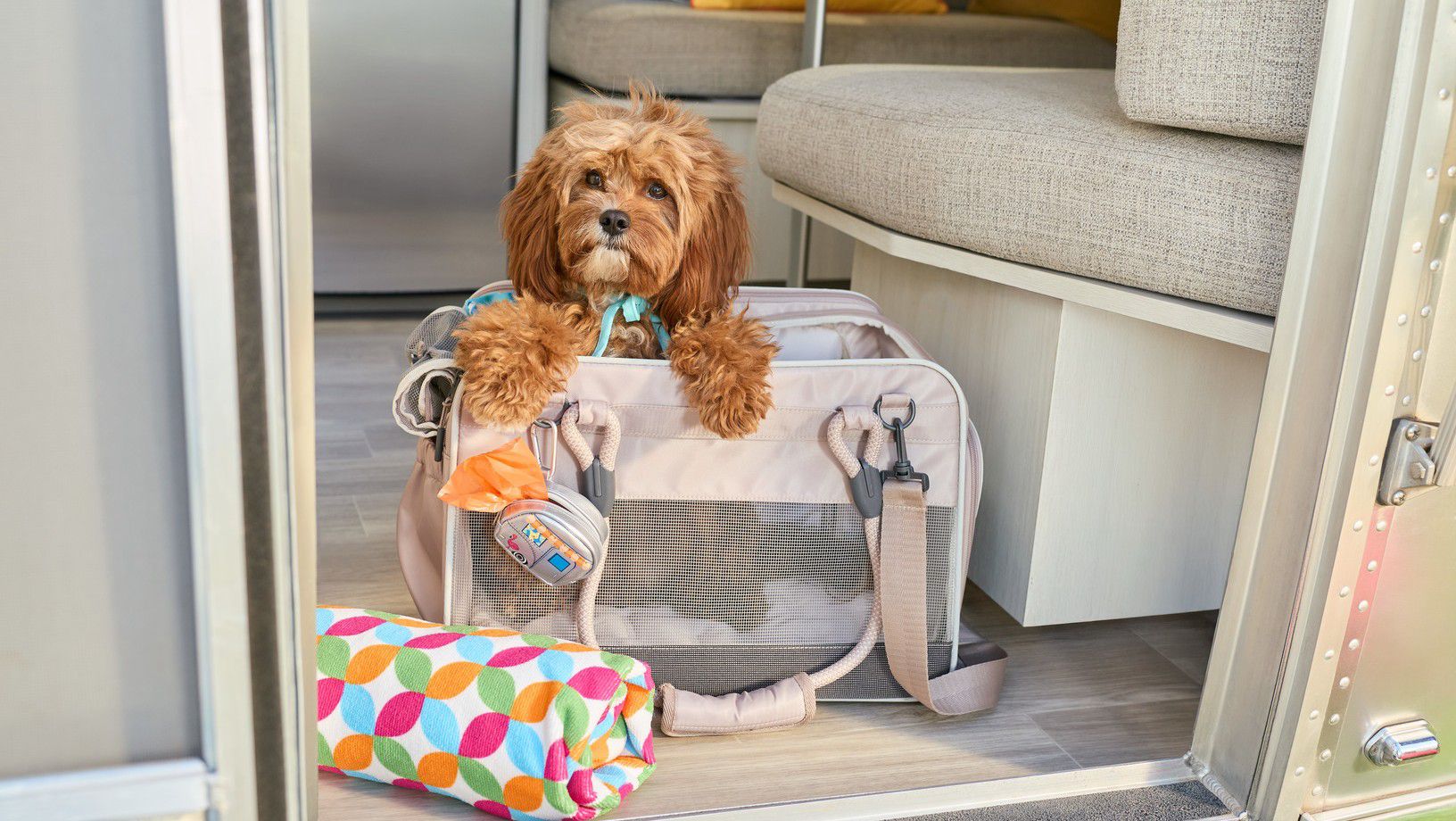
Small dogs that qualify for cabin travel travel in a soft-sided carrier under the seat in front of you. Familiarizing your dog with that specific carrier, not just any carrier, in the weeks before the flight significantly reduces stress. The sounds of a plane, acceleration, lift-off, landing, and pressure changes are all novel experiences that a calm, familiar space helps buffer.
Arrive at the airport early to allow time for exercise and a bathroom break before the flight. Minimize the time your dog spends waiting in the carrier at the gate.
Cargo hold travel
Cargo travel presents significantly more stress and safety considerations. Sedation should usually be avoided for cargo travel unless directed by your veterinarian. It can suppress a dog’s ability to regulate breathing and balance, and there is no one in the cargo hold to monitor or respond if something goes wrong. If cargo travel is required, the crate must be airline-compliant, structurally sound, clearly labeled, and your dog must be thoroughly acclimated to it.
Cargo travel also requires paperwork. Most airlines require a health certificate that your veterinarian completes, and some destinations have additional requirements like vaccination records or testing that can take time to finish. As soon as your travel plans are set, talk to your vet so there’s enough time to complete any required steps before your trip.
Brachycephalic breeds, including Bulldogs, Pugs, French Bulldogs, Boxers, and Boston Terriers, are at elevated risk in cargo holds due to their compromised airways. If you have a flat-faced breed and are considering cargo travel, talk to your vet well in advance. Many airlines also restrict cargo travel during extreme heat or cold, since temperature swings in the cargo hold raise the risk for any dog, but especially for puppies, senior dogs, and brachycephalic breeds. Check airline policies and the forecast at both your departure and arrival cities before booking.
Anxiety medications for flying
If your dog has significant travel anxiety and you’re flying, talk to your vet well before the trip about appropriate options. Anti-anxiety medications (not sedatives) can be appropriate for some dogs flying in cabin. Sedation is generally contraindicated for air travel due to respiratory and balance risks. Any medication should be tested before departure day so you know how your dog responds.
When to involve your veterinarian
Travel anxiety exists on a spectrum. On one end, mild restlessness that resolves once your dog settles. On the other, physical distress that makes every trip genuinely difficult for the dog and the people around them. If your dog is on the more serious end:
- Talk to your vet before the trip, not after. Prescription anti-anxiety medications are available and can make a significant difference, but they need to be prescribed, tested, and ideally trialed before the actual journey.
- Discuss motion sickness specifically. Anti-nausea medications may be part of the solution for dogs who vomit or drool excessively in cars.
- If anxiety is impacting your dog’s quality of life during or between trips, ask for a referral to a veterinary behaviorist or a certified positive-reinforcement trainer. Behavioral modification is a meaningful tool and works best when done systematically with professional guidance.
- If you’re traveling to a different state or country, ask your vet about required paperwork, testing, or vaccination timelines as soon as your trip is scheduled. Some requirements take weeks to complete.
Frequently asked questions (FAQs)
My dog is fine at home but panics in the car. Where do I start?
Start with the crate, not the car. If your dog’s crate feels safe and familiar before it ever goes in the vehicle, you’ve addressed one of the biggest variables. Once the crate is a comfortable space, introduce it to the car while parked and not running. Then short drives with the car running. Build up slowly with high-value treats and calm energy. This process takes days to weeks for most dogs, so start well before your planned trip.
Can I give my dog Benadryl for travel anxiety?
Benadryl isn’t recommended for travel anxiety. Talk to your vet about safe, appropriate options for your dog instead.
Should I sedate my dog for a flight?
No. Sedation can impair a dog’s ability to breathe normally and maintain balance, which is particularly dangerous in the cargo hold where no one can monitor them. Prescription anti-anxiety medications are different from sedatives and may be appropriate for some dogs; talk to your vet about the distinction and what options exist for your dog’s specific situation.
My dog vomits every car ride. Is that anxiety or something else?
It could be either, or both. Motion sickness is a physical response to the vestibular input of car movement and is common, especially in puppies. Dogs who experience consistent nausea in cars can develop a conditioned anxiety response on top of the physical one. Most puppies outgrow motion sickness as they mature, so keep practicing positive car experiences as your dog grows. If it doesn’t improve over time, talk to your vet about anti-nausea medication, which can help break the physical cycle while you work on the behavioral piece through gradual positive exposure.
How do I help my dog settle in a hotel room?
Set up wherever your dog normally sleeps first, before they explore, whether that’s a crate, a bed, or right next to you. Give them time to sniff the room without rushing them toward a corner or bed. Keep your own energy calm and low-key. Stick to the usual feeding and bedtime routine as much as possible. A familiar-smelling blanket or toy helps anchor the space. Most dogs settle meaningfully faster on the second night than the first.
Information in this article is not intended to diagnose, treat or cure your pet and is not a substitute for veterinary care provided by a licensed veterinarian. For any medical or health-related advice concerning the care and treatment of your pet, contact your veterinarian.