Best Cat Halloween Costumes 2026: Safe Styles Cats Will Actually Wear
In this Article
Key takeaways
- Not every cat is a costume cat, and a festive bandana or themed collar is a completely respectable alternative to a full outfit
- The costume should not restrict movement, vision, breathing, or your cat’s ability to groom themselves
- Introduce any costume over several days with treats and positive reinforcement, not in one go on Halloween night
- Your cat’s body language tells you everything: a cat who freezes, crouches, or goes into slow motion while wearing something is not having fun
- Never leave your cat unsupervised in a costume, even for a few minutes
Cats have opinions. Strong ones. Their opinion on Halloween costumes tends to fall somewhere between profound indifference and theatrical offense. The cat who serenely models a spider outfit while their person gets the perfect photo is a real cat who exists, and the cat who immediately collapses onto their side in protest the moment a hat approaches is equally real and equally valid.
The good news is that there’s a version of cat Halloween dressing that works for almost every personality type, from the fully costume-tolerant to the absolutely-not. This guide covers how to find out which category your cat belongs to, how to try a costume the right way, and how to keep everyone safe on Halloween regardless.
First: is your cat a costume cat?
Before you fall in love with a tiny shark fin or a miniature witch hat, it’s worth doing an honest assessment. Some cats genuinely don’t mind wearing things. They walked into kittenhood confident and curious, they tolerate all kinds of handling, and they’ll wear a small costume with nothing more than mild bemusement. Other cats find any sensation of clothing deeply upsetting, and that’s not a training failure or a personality flaw. It’s just your cat.
A useful early test: gently drape a lightweight fabric scrap over your cat’s back and watch what happens. A cat who shakes it off immediately and walks away is telling you something different from one who sniffs it and keeps doing what they were doing. Neither reaction is wrong, but they point toward very different Halloween approaches.
Body language that says “not for me”
- Freezing in place or moving in a low, exaggerated slow-motion creep
- Ears flattened sideways or back
- Tail lashing, tucked, or puffed
- Crouching close to the ground
- Attempting to roll, shake, or scratch the costume off immediately
- Growling, hissing, or refusing treats they would normally take
If you see several of these together, the costume isn’t working for your cat. A Halloween bandana, a seasonal collar, or a tiny clip-on bow is a perfectly charming alternative that many cats tolerate much better than a full outfit.
Introducing a costume the right way
The fastest path to a miserable Halloween photo is pulling a costume out of the bag five minutes before you want to take pictures. The actual approach that works takes a few days and requires treats.
- Day 1: Leave the costume near your cat’s favorite spot. Let them sniff it, walk past it, and decide it’s not a threat. No pressure to interact.
- Day 2: Hold the costume near your cat while offering a treat. Associate it with something they like.
- Day 3: Drape it loosely over their back for a few seconds. Treat immediately. Remove before they protest. End on a positive note.
- Day 4: Fasten the costume briefly while your cat eats a treat or plays. Keep the session under a minute. Reward the whole time.
- Day 5: A short full session with your cat moving around normally in the costume, with treats throughout.
This timeline sounds slow until you skip it and discover that your cat has opinions about timelines too.
Costume styles that tend to work for cats
The best cat costumes are lightweight, minimal, and don’t dramatically change your cat’s range of motion or sensory experience. A few styles that tend to go over better than elaborate outfits:
Cape or collar add-ons
A small cape attached at the collar level or a festive collar with Halloween detailing is often the most tolerated option. It’s minimal, it doesn’t touch most of the body, and it’s easy to get on and off. A vampire cape on a black cat is objectively iconic and requires about 30 seconds of your cat’s patience.
Bandanas and bows
A Halloween-themed bandana tied loosely around the neck, or a clip-on bow on a collar, gets you into the spirit of things with almost no discomfort risk. Most cats who object to full costumes accept these without protest. These are also the go-to for cats who tolerate clothing for about 45 seconds before reconsidering.
Lightweight full costumes
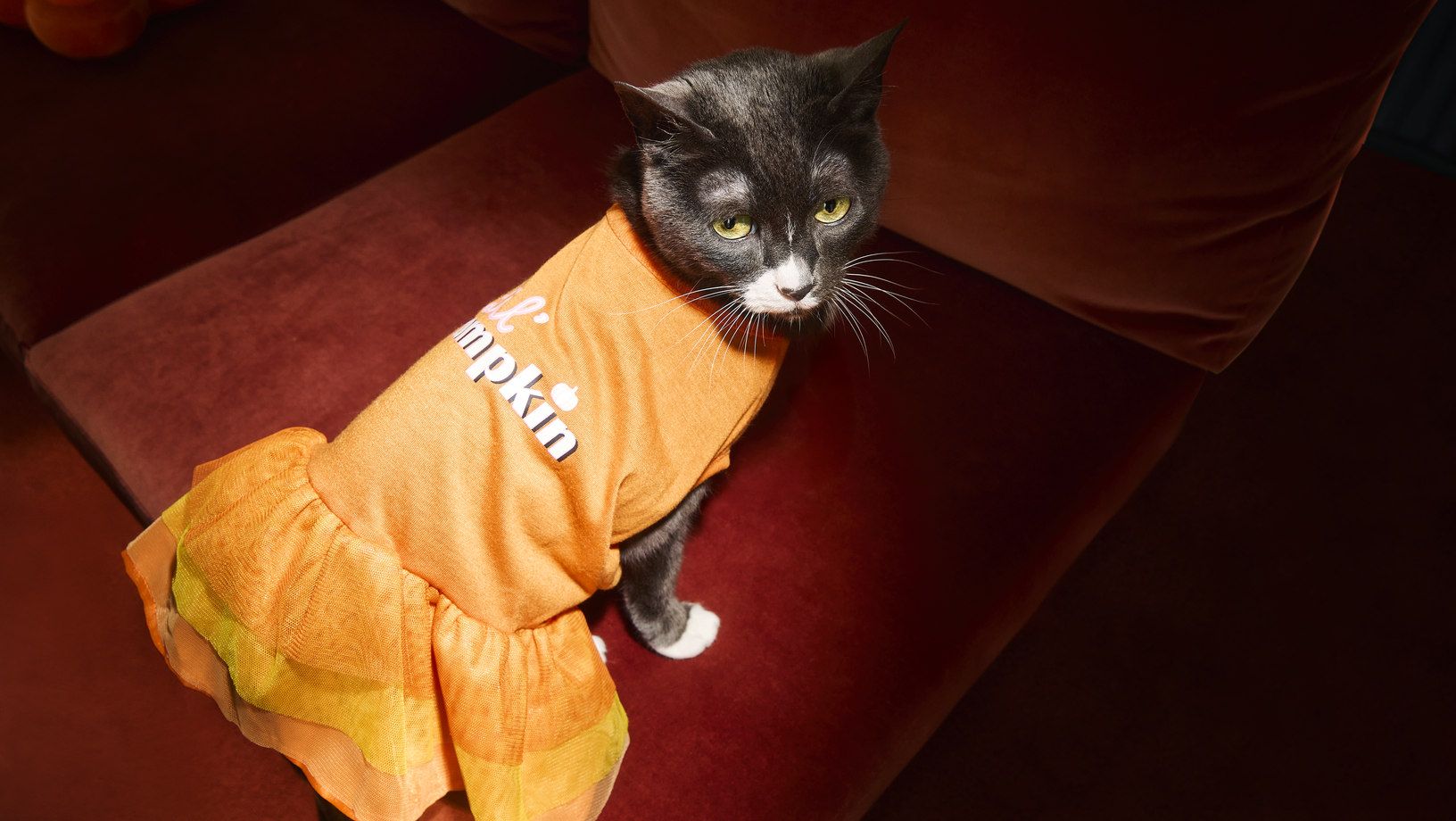
For cats who genuinely tolerate wearing things, lightweight fabric costumes that slip over the body without tight elastic or restrictive sleeves tend to work better than structured outfits. A simple fabric tube with head and leg openings, a small pumpkin or hot dog design, gives you the full costume effect without a lot of construction around the cat. Browse cat Halloween costumes and accessories in the PetSmart Cat Shop to see seasonal options.
The photo-only hat
A witch hat balanced briefly on a cat’s head for a single photo, with treats in front of them and someone steadying the hat from behind, is a time-honored tradition that doesn’t require your cat’s advance agreement. Keep the session under 30 seconds, reward generously, and call it a win.
Fit and safety checklist
Whatever you choose, run through these before your cat wears it:
- Your cat can breathe, open their mouth, and pant without restriction
- Their vision is completely unobstructed in all directions
- They can walk, sit, and jump normally
- They can groom their face and body
- There are no small decorative parts that could be chewed off and swallowed
- No elastic or closures are tight enough to restrict circulation
- You can get it on and off quickly if your cat becomes distressed
And the rule that applies regardless of costume quality: never leave your cat unsupervised in a costume. Cats investigate clothing with their teeth and claws, and a seemingly secure costume can become a tangle hazard within minutes of you leaving the room.
Halloween safety beyond the costume
Halloween brings a few household hazards worth knowing about even if your cat never wears a stitch.
- Candy: Chocolate and xylitol (found in sugar-free candies and gum) are toxic to cats. Keep the candy bowl well out of reach and brief any visitors about not sharing.
- Decorations: Fake spiderwebs are a tangle and ingestion hazard. Lit candles and jack-o-lanterns are a fire risk in a home with a curious cat. Glow sticks are non-toxic but cause dramatic drooling and foaming if chewed.
- Doorbell traffic: Repeated doorbells and unfamiliar visitors in costumes can be genuinely stressful for some cats. Setting up a comfortable room with their usual bedding, away from the front door, gives them somewhere to decompress.
- Keep cats indoors: Halloween is one of the nights when keeping all cats, and especially black cats, safely inside is particularly important. The combination of increased foot traffic, unusual activity, and open doors creates more escape opportunities than a typical evening.
- ID and microchip: Make sure your cat’s microchip registration is current before any Halloween gathering that involves your front door opening frequently.